The thoughts running the show
Every leader carries a set of beliefs about themselves, their work, and what's possible. Most of those beliefs are useful — they help you make fast decisions and navigate complexity. But some of them aren't. They're the ones that quietly tell you you're not ready, that it's faster to do it yourself, that saying no will cost you the relationship, or that one missed deadline will ruin your reputation.
These are limiting beliefs. They feel like facts. They sound like common sense. And they're probably the single biggest thing standing between you and the goals you keep missing.
What limiting beliefs actually are
A limiting belief is a thought you've rehearsed so many times it started sounding true. It's not a character flaw or a weakness — it's a pattern of thinking your brain learned at some point and never updated.
The tricky part is that they don't announce themselves. They show up as "just being realistic" or "knowing yourself." You don't question them because they feel like you.
But here's the thing: they're not you. They're thoughts. And thoughts can be examined, challenged, and changed.
How they show up at work
Limiting beliefs don't live in a journal. They live in your daily decisions. Here's where they tend to appear.
Pricing and value
You know you're undercharging, but the thought of raising rates triggers "who am I to charge that much?" or "clients will leave." So you keep your prices where they are and resent the work.
Delegation and control
You believe "if you want it done right, do it yourself." It feels efficient. But every hour you spend doing someone else's job is an hour you're not leading, strategizing, or resting. Your team never grows, and neither do you.
Scope and boundaries
A client asks for something out of scope and you say yes because saying no feels too uncomfortable. You absorb the extra work, quietly resent them, and teach them that your boundaries don't matter.
Visibility and growth
You're invited to speak, present, or step into a bigger role. Your first thought: "I'm not ready for that" or "someone more qualified should do it." So you decline. And the opportunity passes to someone with less skill but more confidence.
Risk and decision-making
Your mind goes straight to the worst-case scenario. A slow month becomes "this is the beginning of the end." A project delay becomes "this will ruin my reputation." You plan around disasters that haven't happened and miss the moves that would actually grow your business.
Why they block your goals
Here's the mechanism: a limiting belief shapes your perception, your perception shapes your actions, and your actions create evidence that confirms the belief. It's a cycle that feeds itself — and the unsettling part is how invisible it is while it's running.
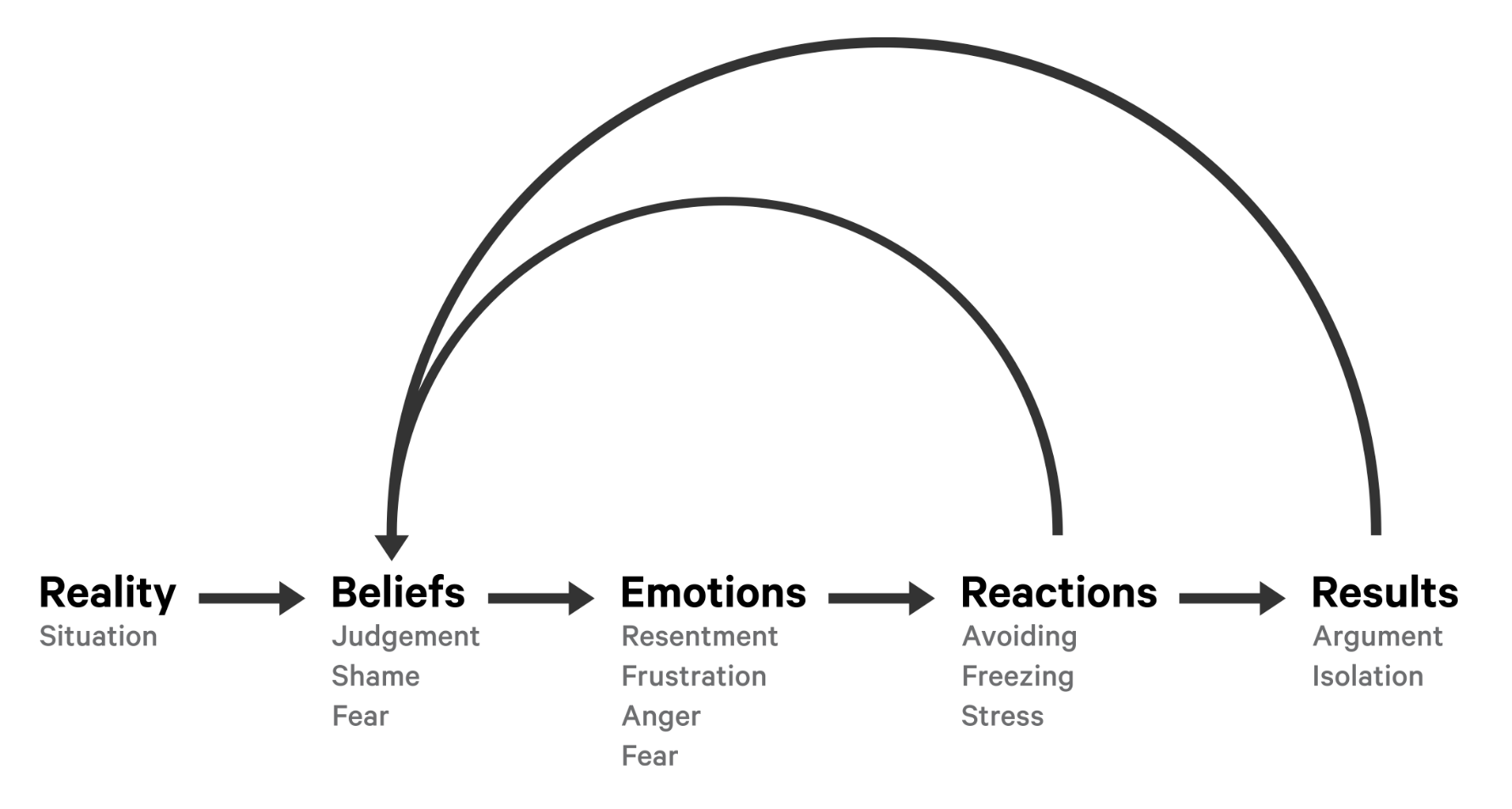
The cycle, stage by stage
Formation. Most limiting beliefs didn't form yesterday. They took shape much earlier — in childhood, in a painful failure, in a moment where a particular conclusion kept you safe. "If I stay small, I won't get noticed for the wrong things." "If I do it all myself, no one can let me down." At the time, the belief was adaptive. It was a strategy that worked.
Going underground. The strategy worked so well it stopped needing to be a strategy. It sank below awareness and became a lens — a default way of seeing yourself, other people, and what's possible. As the handout puts it, these beliefs become the filter through which you interpret the world. You stopped hearing it as a belief and started hearing it as reality.
Perception as filter. Once a belief is a lens, it doesn't just colour what you see — it selects it. You notice the one client who left and miss the nine who stayed. You remember the time delegation backfired and forget the times it didn't. The belief feeds you the evidence it wants you to have.
Action and avoidance. The filtered perception drives your choices, usually toward avoidance. You don't raise the rate, don't hand off the task, don't take the stage, don't say no. Avoidance feels safe — which is the whole point of the original strategy.
Confirmation. The avoidance produces the very outcome the belief predicted. Stay invisible and you don't get the promotion — "see, I'm not enough." Don't delegate and you stay overloaded — "see, no one can be relied on." The belief gets the proof it was looking for, and the proof makes the lens stronger.
The cycle tightens. Each pass makes the next pass easier and the exit harder. The belief that started as a small, sensible conclusion hardens into something that feels like character, like fate. This is why willpower doesn't fix it. You can't out-work a belief that's quietly steering your decisions in the wrong direction — because it's steering from a place you're not looking.
- Believe you're not enough → avoid visibility → stay invisible → conclude you're not enough.
- Believe no one can do it as well as you → don't delegate → stay overloaded → conclude you can't rely on anyone.
- Believe there isn't enough → operate from scarcity → compete instead of collaborate → confirm there isn't enough.
The belief doesn't just block one goal. It blocks the category of action that would get you there. You don't just fail to raise your rates — you fail to become the kind of leader who charges what they're worth. You don't just fail to delegate — you fail to build a team that can run without you.
The part you're not seeing
Jung had a way of describing this. He called the emotionally charged clusters of thought, memory, and feeling that live in us complexes — and he noticed they behave almost like little personalities of their own, quietly running the show from the basement. A limiting belief is a complex in plain language: an old, feeling-toned pattern you didn't choose and don't run, but that runs you when you're not paying attention.
The trick of the complex is projection. When a belief is unconscious, you don't experience it as yours — you experience it as the world. "Clients will leave" doesn't feel like your fear; it feels like a fact about clients. "I'm not ready" doesn't feel like a story; it feels like an accurate self-assessment. You're not seeing the situation. You're seeing your belief reflected back at you and calling it reality.
This is what Jung meant when he said that what remains unconscious doesn't go away — it shows up in your life as fate. The leaders who keep hitting the same wall, losing the same kind of opportunity, hiring the same kind of problem aren't unlucky. They're being run by a belief they haven't seen yet. The pattern repeats because the cause hasn't been brought into the light.
And that's the whole turn. The cycle isn't broken by effort. It's broken by seeing. The moment a belief moves from the unconscious into the light — named, examined, recognized as a thought rather than a truth — it starts to lose its grip. The lens doesn't vanish, but it stops being invisible, and you can take it off. That's individuation in a sentence: less about becoming someone new, more about ceasing to be run by parts of yourself you've never met.
Try this: Next time you're stuck, ask yourself "what do I believe is true here?" — then "how do I know?" The gap between those two questions is where the belief lives, and where the seeing starts.
How to interrupt the cycle
The good news: beliefs are thoughts, and thoughts can be examined. The process is simple, even if it's not easy.
1. Surface the belief
Catch the thought that runs through your mind in stuck moments. "I can't raise my rates because…" — what comes after because? That's the belief. Say it out loud or write it down. Naming it is the first step to changing it.
2. Examine the evidence
List the evidence that supports the belief. Then — and this is the part most people skip — list the evidence that contradicts it. You'll almost always find more contradiction than you expected. The belief felt true because you only counted the hits.
3. Reframe the belief
Rewrite it as something honest and empowering. Not toxic positivity — just accurate. "I'm not ready" becomes "I'm as ready as most people who do this, and I'll learn the rest by doing it." The reframe has to feel true, or your brain will reject it.
4. Act differently
Take one small action the old belief would have stopped you from taking. Raise one rate. Delegate one task. Say no to one scope-creep request. Each action builds evidence that the new belief is true — and slowly, the cycle starts working for you instead of against you.
The Work: a field-tested version of this inquiry
This isn't new territory. The teacher Byron Katie built an entire practice around it called The Work — a simple, four-question inquiry you run on any stressful belief. The questions are:
- Is it true?
- Can you absolutely know it's true?
- How do you react, what happens, when you believe that thought?
- Who would you be without the thought?
Then comes the turnaround — flipping the belief to its opposites and finding where each one is as true, or truer, than the original.
What makes The Work so effective is that it doesn't argue with the belief or swap in a cheerier one. It just asks you to look — closely, honestly, at the actual evidence — until the belief loosens on its own. That's the seeing this whole cycle is waiting for. You're not reprogramming yourself with a new slogan; you're dismantling the old one by refusing to let it pass as fact.
The bottom line
The biggest thing holding your business back probably isn't a systems problem, a team problem, or a market problem. It's a thought you don't know you're having. The moment you can see it, it starts to lose its power. And the moment it loses its power, the goals that felt out of reach start looking like next steps.
Zoom out: to see how these belief patterns play out across the whole founder's journey — archetype by archetype, stage by stage — read How founders grow up.

Newsletter
Get more like this in your inbox
Sharp opinions on operations, systems, and the psychology of how work gets done. No fluff. Unsubscribe anytime.